Purpose of this document
This document reports findings from Odoki’s initial data collection period, describes methodological and theoretical developments since September 2024, and states the research questions we are now pursuing. It should be read alongside Odoki: Theoretical Foundations and Research Intent, which records our theoretical foundations and research intent prior to data collection.
Development of the protocol
Since October 2024, the Odoki protocol has matured significantly. We now have a defined delivery pathway that reliably brings participants to stage 10 -- full completion of the process. This is a meaningful threshold: it means the method is sufficiently systematised to be taught to and delivered by trained guides working under supervision, and that outcomes can be assessed against a consistent standard.
The area where active development continues is for participants who do not naturally access somatic inquiry -- described below. For participants who can access it readily, the protocol now works reliably.
Theoretical developments
The necessity of somatic grounding
As Odoki: Theoretical Foundations and Research Intent noted, following Barrett, that the relevant prediction error must occur at the level of interoceptive prediction rather than conceptual belief. Since then, this has moved from theoretical inference to operational necessity: we have found empirically that when inquiry remains conceptual or narrative in character it does not produce meaningful update, regardless of the participant’s intellectual engagement with the process.
The construct we use for this is Eugene Gendlin’s “felt sense” -- the pre-conceptual, bodily-felt dimension of experience that Gendlin identified as the substrate of genuine psychological change. We map felt sense directly to predictive interoception in Barrett’s framework: it is the signal at which the relevant generative model must be updated for change to occur. This mapping is our own theoretical contribution and we hold it as a hypothesis rather than a settled claim.
Prior framework interference
We anticipated in Odoki: Theoretical Foundations and Research Intent that client recruitment through Buddhist and social networks might produce a cohort skewed toward people already open to inquiry-based practice, and noted this as a potential limitation. The finding has been more specific and more interesting than anticipated.
Participants with an established structured inquiry framework -- including those with prior Ten Fetters experience and some somatic practitioners -- have commonly proven harder to work with than participants without such frameworks. Our account of this is mechanistic: these participants are not simply looking at experience, they are looking for what their existing model tells them should be there. The prior framework actively shapes attention, obscuring the prediction error the inquiry is designed to generate.
Counterintuitively, participants with therapeutic training have tended to engage well with the process. We hypothesise that therapeutic training cultivates the capacity to attend to another’s experience without imposing a framework -- a disposition that, turned inward, may reduce competing-model interference. We intend to test this further with mindfulness practitioners, where the prediction is less clear.
The most straightforward clients have been “ordinary” people - friends and family plus people contacted through business connections. When these types of people are given a model of the mind that includes the felt sense, it is more likely that this model will just land in a way that sets them up for the rest of the protocol. This is in contrast to people with prior inquiry experience.
Cohort and data
Participants
Thirty participants have had meaningful engagement with Odoki between September 2024 and April 2026. Of these:
- 18 submitted both before and after measurement data
- 14 completed the full protocol to stage 10
The 18 participants with before/after data and the 14 completers have not yet been correlated in our dataset. Some of the 18 therefore include participants who did not receive the full benefit of the completed protocol. This is a limitation we note explicitly.
Data collection was inconsistent during the later part of the window, reflecting insufficient emphasis on survey completion at that stage. The data is therefore skewed toward earlier deliveries, which used a less developed protocol. Current delivery is more consistent and more complete. The 30-person cohort now being recruited will test the refined protocol under more rigorous data collection conditions.
Instruments
QIDS-SR, GAD-7, and WEMWBS, as described in Odoki: Theoretical Foundations and Research Intent. QIDS-SR is being phased out in favour of PHQ-8 for the next cohort, for reasons of suitability in corporate settings. GAD-7 and WEMWBS are retained. We will use PHQ-9 in contexts where the “suicidality” clause is acceptable.
Findings
Summary
Across the 18 participants with complete before/after data, we observe approximately 40% average improvement in depression and wellbeing scores.
Depression and wellbeing
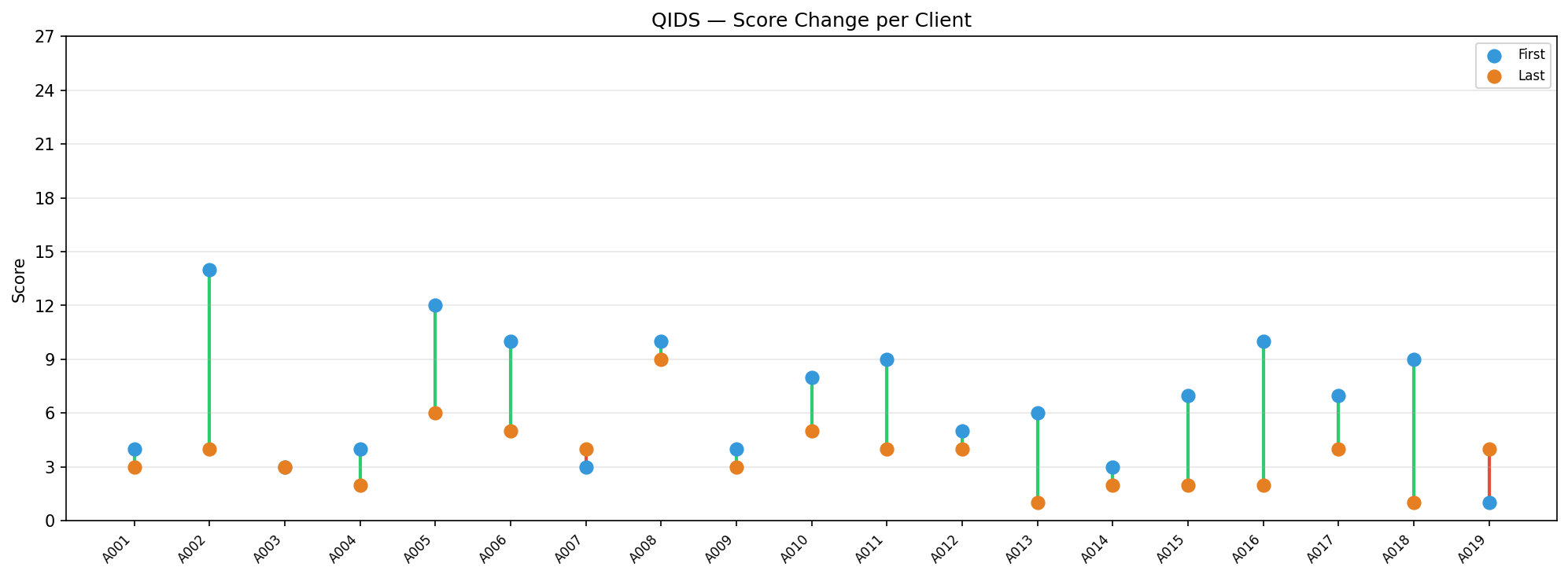
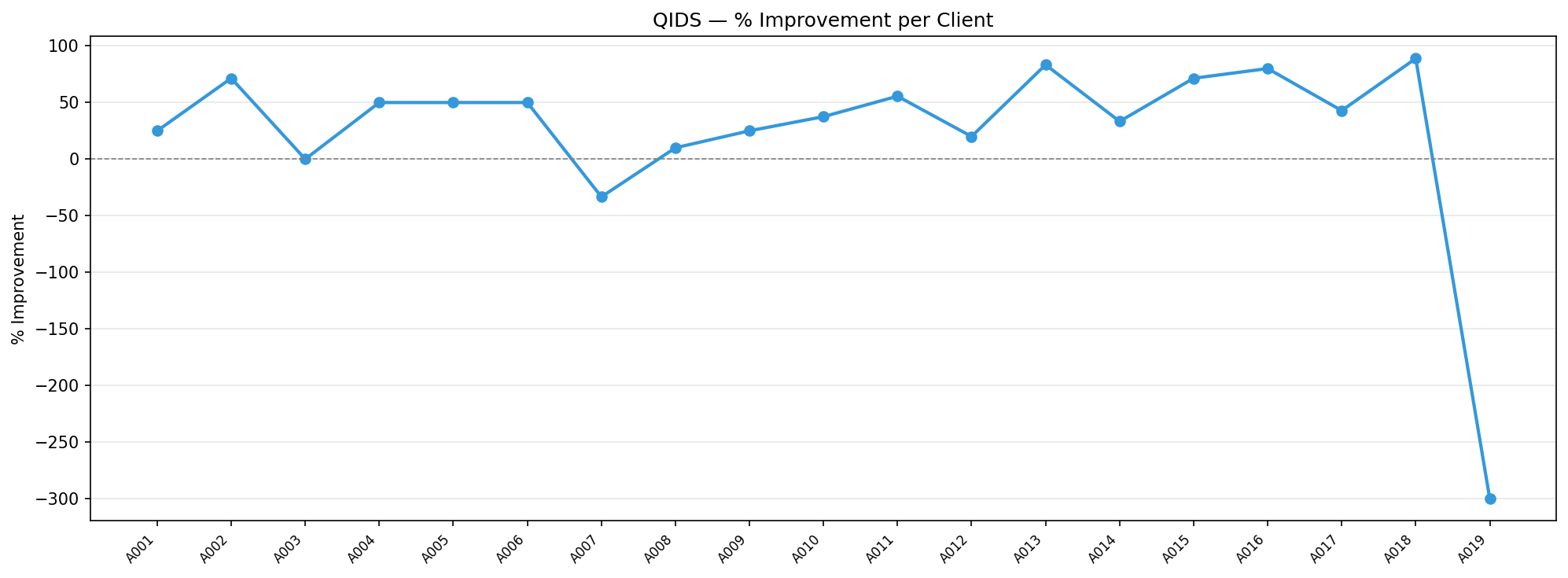
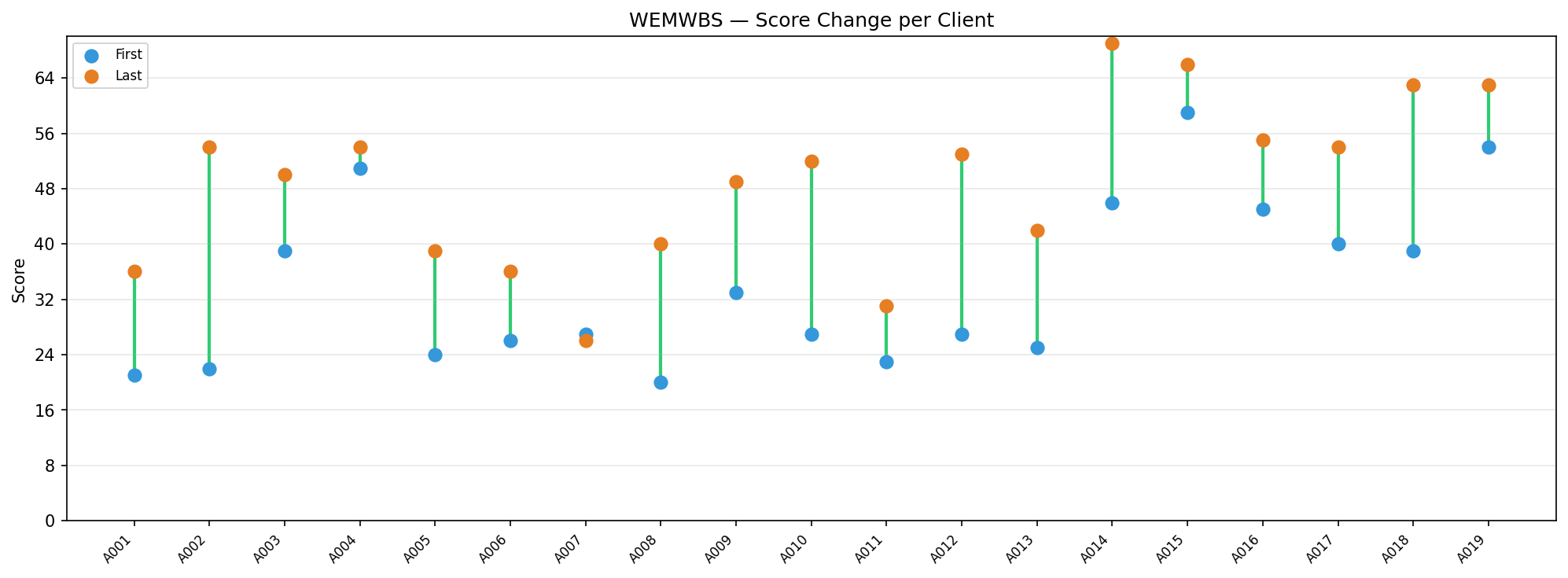
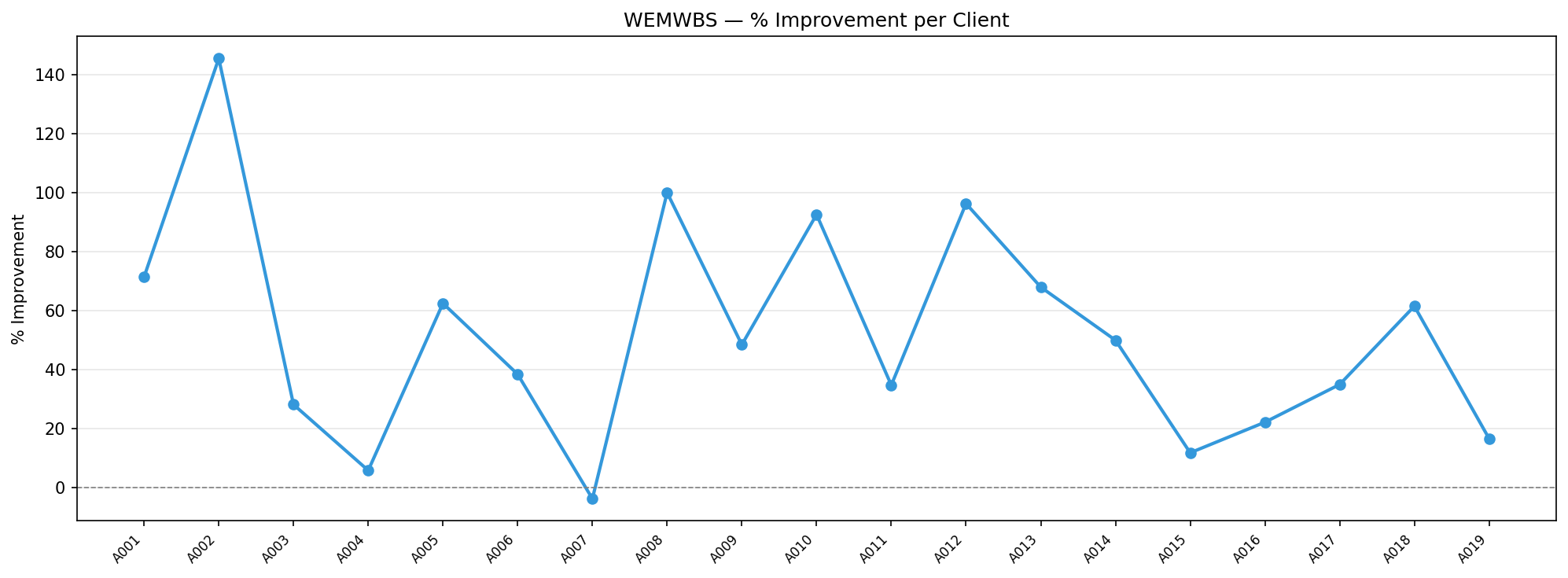
[INSERT: commentary on whether improvements move participants out of clinical range, and whether WEMWBS improvement is proportionate to or greater than depression improvement]
Anxiety
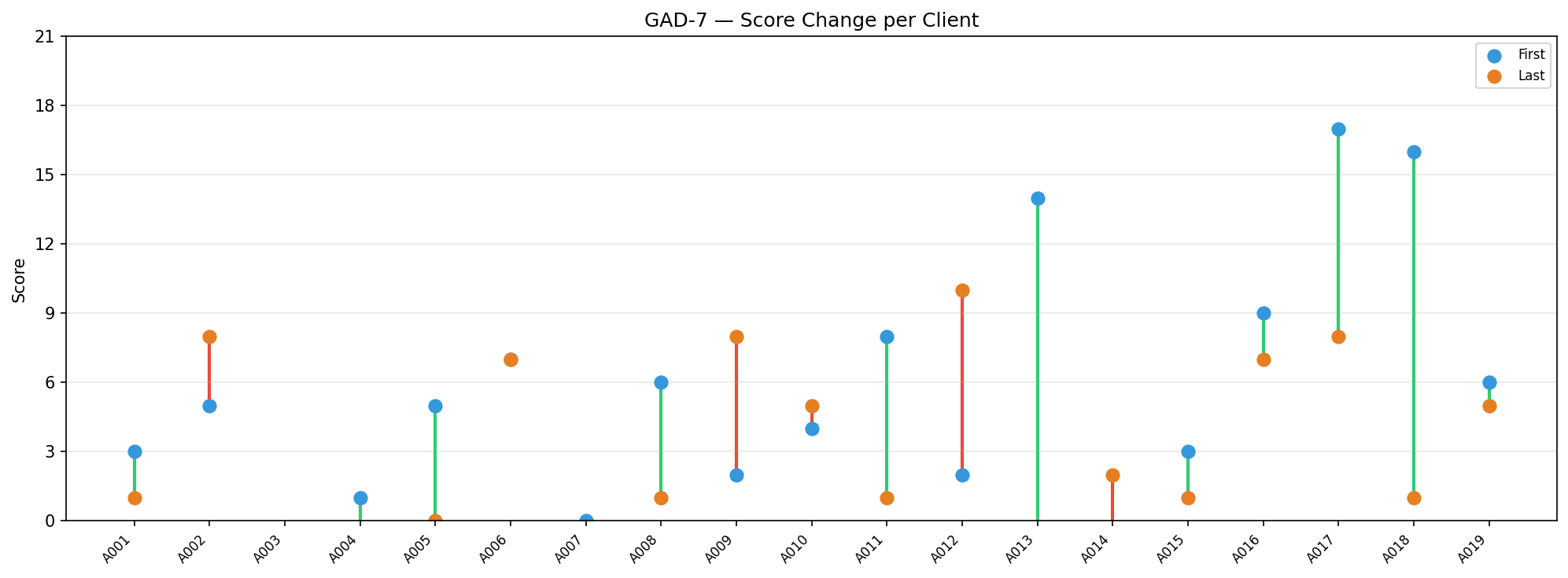
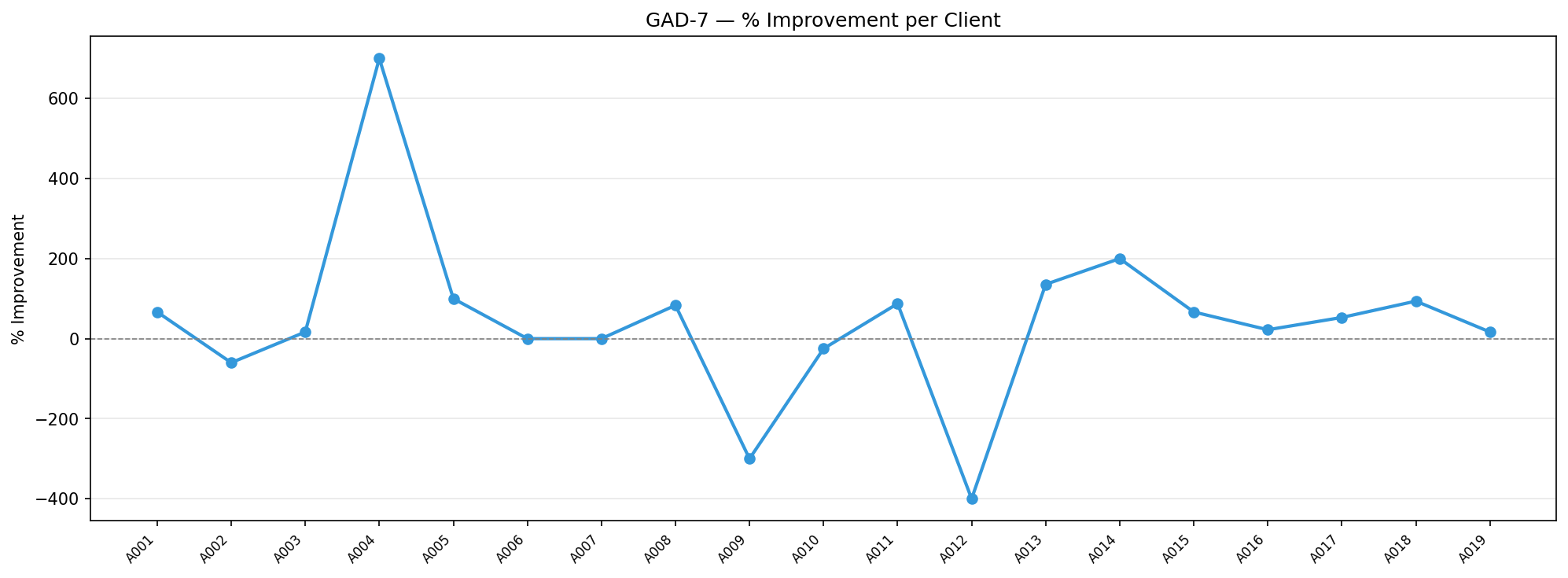
GAD-7 results are mixed and warrant specific comment. Our current hypothesis is that depression relief unmasks previously suppressed anxiety: as the affective weight of depression lifts, anxiety that was present but less salient becomes more apparent to the participant. If this account is correct, GAD-7 scores might be expected to show initial increase or stasis before subsequent reduction with continued engagement. This is a specific and testable prediction for the next cohort.
Individual trajectories
[INSERT: per-participant before/after plots showing individual trajectories across all three measures]
The distribution of individual outcomes is more informative than aggregate means. [INSERT: commentary on clustering, outliers, and any apparent bimodal distribution]
The “just works” population
A subset of participants engages with the somatic inquiry immediately and without apparent difficulty. For these participants, the process is reliable and the outcomes are consistent. We describe this informally as the process “just working.”
We do not yet have a clean prospective means of identifying these participants. Retrospectively, they appear to share a capacity to attend to felt bodily experience directly, without immediate translation into narrative or conceptual terms -- which maps to the interoceptive sensitivity construct in Barrett’s framework.
The open research questions here are:
- Can this population be identified prospectively, and if so by what means?
- What additional steps can be taken, and formalised, to allow for teaching the necessary capacity to attend to felt bodily experience.
- What additional audiences does this Method (with or without the additional felt sense training) offer benefit to?
Active development: participants who struggle with somatic inquiry
For participants who do not naturally access the felt sense, we have had some success with preparatory approaches that develop interoceptive awareness prior to or alongside inquiry. This work is ongoing and not yet sufficiently systematised to report findings. It represents the primary area of active methodological development.
The hypothesis is that somatic accessibility is not a fixed trait but a trainable capacity, and that developing it is a precondition for the inquiry to produce genuine update rather than conceptual engagement. Confirming or disconfirming this is a research priority.
Forward research plan
The 30-person cohort
We are currently recruiting a cohort of 30 participants. This cohort will differ from the initial data collection in several respects:
- Consistent use of PHQ-8 rather than QIDS-SR
- Delivery under the refined, completed protocol
- Rigorous before/after data collection from the outset
- Guided by trained guides working under supervision, not only by the Method’s originator
The last point is significant: if outcomes under supervised guide delivery are consistent with outcomes under direct delivery, this supports the transmissibility of the Method and its readiness for a more formal study.
Research questions for the next stage
- Do outcomes from the refined protocol, measured consistently, replicate and improve on the initial cohort findings?
- Does the anxiety pattern (mixed GAD-7 results) resolve, persist, or clarify with a larger and more consistently measured cohort?
- Can the “just works” population be characterised prospectively?
- Do therapists with professional training show systematically better outcomes than those without?
- Does preparatory somatic work improve outcomes for participants who initially struggle with interoceptive inquiry?
What we are looking for from researchers
We are not yet at the stage of proposing a controlled trial. What we are seeking is:
- Help framing a study design appropriate to the current evidence stage
- Input on whether our instrument selection is optimal for the constructs we are measuring
- A conditional research relationship, contingent on the 30-person cohort data and funding being in place
We believe the signal is strong enough to warrant serious attention. We do not believe it is strong enough yet to make claims beyond that.
Odoki Team - April 2025